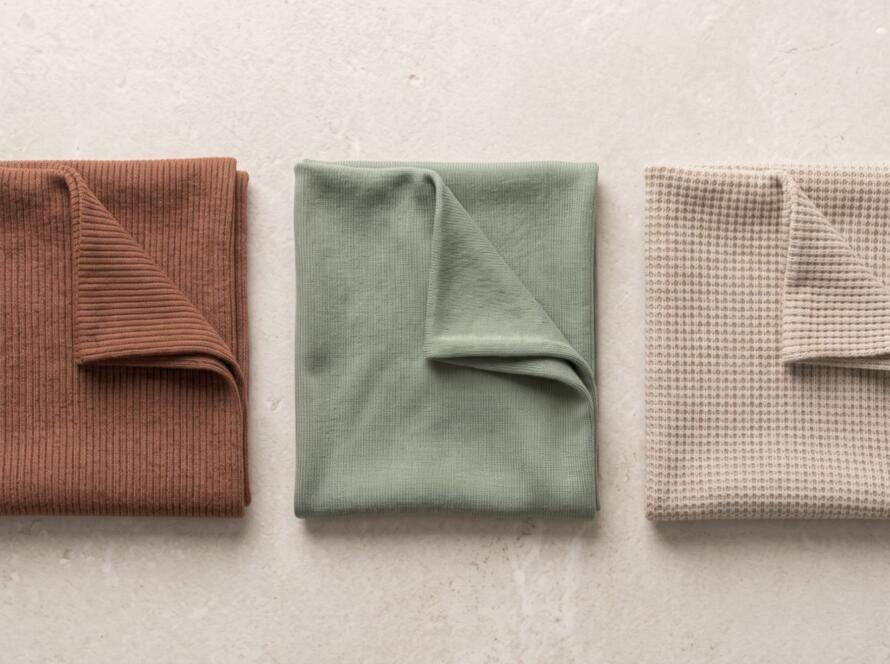
Interlock fabric; çift plakalı yuvarlak örme makinelerinde, silindir ve kapak iğnelerinin karşılıklı olarak simetrik bir düzende yerleştirilmesiyle üretilen, ön ve arka yüzü tamamen aynı pürüzsüz görünüme sahip çift katlı tek bir örme kumaş Interlock fabric is a double-layer, single-piece knit structure produced on double-cylinder circular knitting machines, where the cylinder and dial needles are arranged symmetrically opposite one another, giving the face and back identical, smooth surfaces. Thanks to its tight, non-porous and full-bodied texture, this fabric type offers high dimensional stability, and is known for not curling at cut edges and recovering perfectly to its original shape after stretching. Its most common applications include high-quality baby and children's wear, premium pajama sets, luxury sportswear, and smart-casual ready-to-wear collections that require a substantial drape. Offering ease of sewing, a low-waste cutting advantage and high thermal insulation during manufacturing, interlock is one of the most preferred quality product groups for brands sourcing wholesale fabric that seek both durability and a soft, skin-friendly hand.
In the ready-to-wear industry and luxury textile production, the structural quality of the fabric is the single most important factor that determines the premium look of a design. How long a collection stays crisp and flawless on the store hanger, and how well it retains its shape after washing, depends entirely on the chosen stitch structure. Among the rich variety offered by the knitting world, interlock fabric is undoubtedly one of the most technical constructions, standing out for its smooth surface and substantial body. Creating high added value across a wide range from baby wear to luxury sportswear, this construction is regarded as one of the most prestigious outputs of modern fabric production processes.
What Is Interlock Fabric? A Look at Its Technical Properties
İnterlok kumaş, çift iğne yatağına sahip özel yuvarlak örme makinelerinde üretilen, iki yüzü de düz (V ilmek yapısında) olan çift katlı bir kumaş türüdür. Süprem gibi tek plakalı kumaşların aksine, interlok makinelerinde iğneler birbirine dik ve karşılıklı gelecek şekilde senkronize çalışır. Bu özel örgü geometrisi, iki ayrı ribana örgünün iç içe geçerek kilitlenmesini sağlar; kumaşın ismi de bu kilitlenme (interlock) mekanizmasından gelir.
The technical and physical properties of the fabric can be summarized as follows:
- Double-Face Smoothness: The face and back of the fabric have exactly the same appearance and the same smooth hand. Since the purl stitches are hidden within the inner structure of the fabric, both sides offer a smooth touch against the skin.
- Memory and Dimensional Stability: Its stretch capacity in both width and length directions is balanced. After being stretched, it returns to its original shape with a reliable elastic memory; as a result, it does not leave knee or elbow bagging in garments.
- No Edge Curling: Its cut edges do not roll up. This feature gives manufacturers a major speed advantage during garment assembly and sewing, along with low-waste cutting.
- High Thermal Insulation: The micro air pockets trapped between the two knit layers give the fabric a natural thermal barrier effect. As a result, it retains body heat exceptionally well.
Areas of Use for Interlock Fabric According to Industry Needs
These technical advantages offered by interlock constructions make it the number-one choice in many specialized applications where standard knit fabrics fall short, and where both firmness and a delicate hand are required at the same time.
1. Premium Baby and Children's Wear
Baby skin is extremely sensitive, and garments in direct contact with it must be smooth, free of harsh chemicals, and non-irritating. The absence of purl stitches on the back of interlock fabric, together with its softness on both sides, makes it the safest alternative for baby rompers, onesies, bodysuits and newborn sets. Its tight structure also gives it exceptional resistance to frequent washing, without shrinking or stretching out of shape.
2. Luxury Homewear and Pajama Sets
In the modern homewear trend, where consumers look for both comfort and style at home, interlock stands out for combining fluid drape with a substantial body. Interlock pajama sets, robes and lounge pants knitted from quality cotton or modal-blend yarns offer a silky touch against the skin, while their thermal insulation provides an ideal temperature during seasonal transitions
3. Active Sportswear and Technical Apparel
Interlock fabrics enriched with polyester, polyamide and elastane fibers in particular are indispensable to the sportswear sector. Its stretch structure hugs the body closely without restricting freedom of movement, delivering high performance in leggings, training t-shirts, tennis skirts and lightweight jackets. Its tight stitch construction prevents see-through under stretch (the "squat-proof" property) and gives garments a professional look.
4. Smart-Casual Women's and Men's Ready-to-Wear
Süprem kumaşların In designs where single jersey fabrics are too thin or too fluid, and where sweater knits are too heavy, interlock serves as the perfect bridge between the two. Thanks to its thick, substantial body, it delivers excellent pattern stability for sweatshirts, unlined tailored jackets, draped dresses and the main body of polo shirts.
What Are the Key Differences Between Single Jersey and Interlock?
When sourcing fabric wholesale, knowing the differences between single jersey and interlock is critical for managing your budget and pattern planning correctly:
- Production Single jersey is knitted on a single needle bed and has purl stitches on the back; interlock is knitted on a double needle bed and has flat, right-side stitches on both faces.
- Weight (GSM): Due to their double-layer structure, interlock fabrics are always more substantial, heavier and higher in weight (GSM) compared to single jersey fabrics.
- Workability: While single jersey curls at the edges when cut, interlock stays flat, making it easier to sew on the production line.
- Elasticity: While single jersey stretches more freely in the width direction, interlock has a more controlled, balanced and recovery-oriented stretch.
Correct Fabric Production and Quality Consistency
When choosing interlock fabric for your collections, every stage, from yarn quality to finishing processes (such as chemical finishing and sanforizing), must be managed with great care. Poorly manufactured interlock fabrics can develop problems such as pilling or stitch slippage over time. To prevent this, partnering with manufacturers that apply digital color management and transparently provide laboratory colorfastness test results safeguards your brand's future.
Combining half a century of manufacturing experience with visionary technology, Yurda Örme produces quality fabrics to global standards, ranging from single jersey and interlock to rib knit (kaşkorse) and custom-designed jacquards. Built on sustainability and unwavering reliability, the collection continues to offer high-performance, innovative solutions for the design projects of global brands. Discover and explore these exclusive, OEKO-TEX® Standard 100 certified interlock and knit product groups that will add value to your designs.